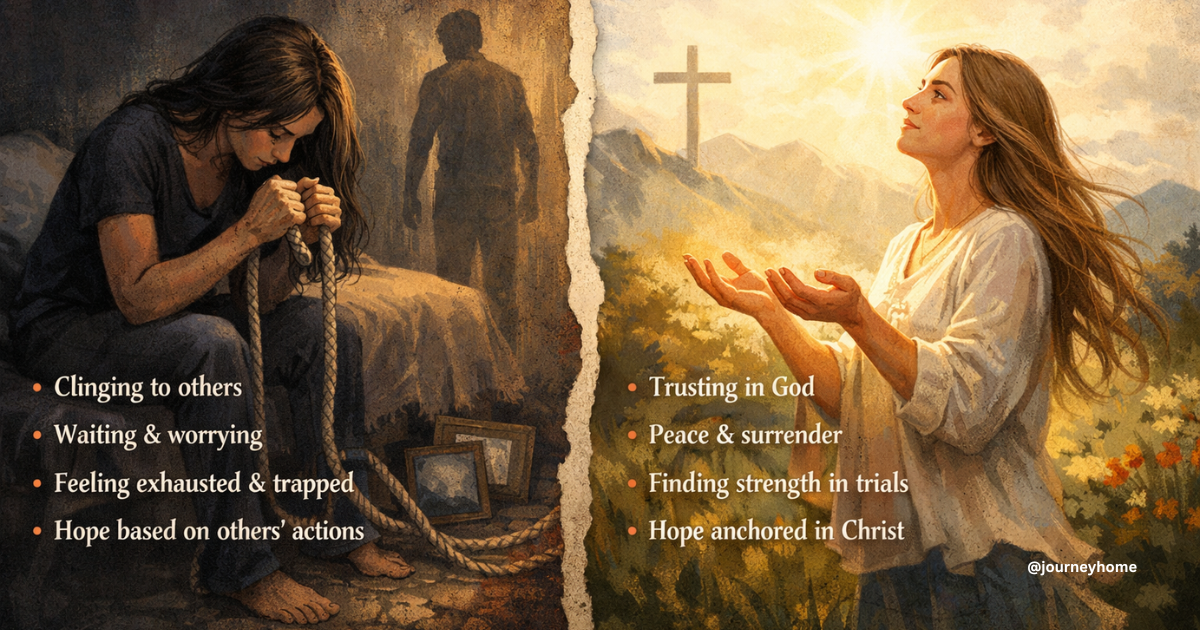
Hope as a Codependent vs Hope as a Christian
Hope wears two different faces depending on who is holding it.
I know this all to well, with three failed toxic marriages. I hoped that if I did the right thing they would change. I did this with my children as well. If their behavior was less that what I considered satisfactory, I would manipulate my response trying to force a change. In the end, it never worked. I have been told for over 30 years now that I suffer from codependency. I thought that once I was given a diagnosis, then by some unknown miracle it would change everything. No it did not!
Codependent hope is a negotiator. It whispers, “If I love harder, stay longer fix better…things will change.” It ties hope to another person’s behavior, like a fragile thread looped around someone else’s choices. When they improve, hope rises. When they don’t hope collapses. It is exhausting because it quietly hands over control, then waits…and waits…and waits.
There is often a hidden contract inside it: “If I sacrifice enough, this will turn out the way I need it to.” But people are not contracts. And how can they sign them without even knowing a contract existed?
Christian hope, by contrast is not a negotiator. It does not beg outcomes into existence. It is anchored not in people. but in God’s character. It says, “Even if nothing changes the way I want, I am still held. I am still guided. I am still not alone.”
One is outcome dependent. The other is presence dependent.
Codependent hope says: “This will work out if they change.” Christian hope says: “This will work out because God is faithful-even if the outcome looks different than I imagined.”
This doesn’t mean Christian hope is passive. It doesn’t mean staying in harm or denying reality. It means acting wisely, loving honestly, and releasing the illusion that you are responsible for another person’s change.
One kind of hope says, “I will save this.” The other says, “I trust the One who saves.”
If your untangling the two, the questions becomes less about “What do I hope for?” and more about “Where is my hope rooted?”
One root drains you. The other sustains you, even on the days when nothing blooms.
Julie Payne


Leave a comment